Why Thin Wall Heat Shrink Matters in Medical Device Manufacturing
Behind every interventional medical device lies a manufacturing challenge most people never consider: how do you bond ultra-thin polymer layers together with extreme precision?
Increasingly, the answer is PET heat shrink tubing.
If you are a medical device R&D engineer or procurement professional, you already know that selecting the right thin wall heat shrink is not a routine sourcing decision. The wrong wall thickness can push your entire catheter's OD out of spec. The wrong shrink temperature can warp sensitive substrates. The wrong material can fail biocompatibility testing late in development — costing months and significant expense.
This guide covers everything you need to know: fundamental performance parameters, a head-to-head material comparison, a selection framework, and real-world application scenarios. Whether you are developing the next generation of interventional devices or sourcing components, by the end of this article you will know exactly what to specify — and what to avoid.
What Is PET Heat Shrink Tubing?
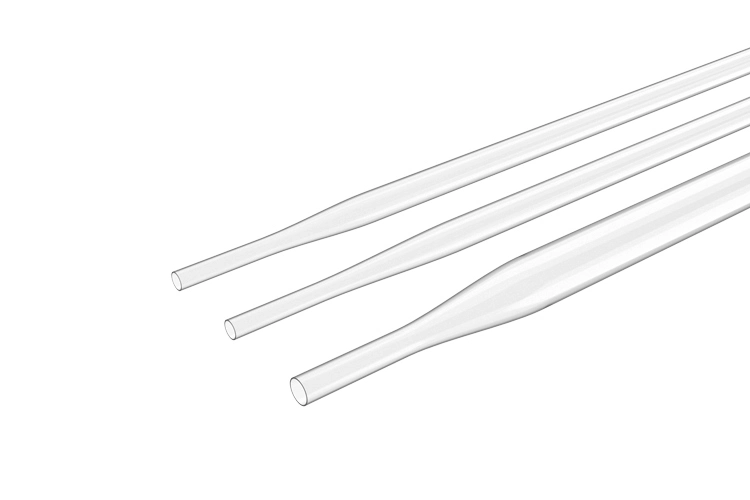
PET (polyethylene terephthalate) heat shrink tubing is a thin-walled polymer sleeve that contracts uniformly when heated, applying radial compression force to whatever it surrounds. In medical device manufacturing, it primarily serves as a processing aid — in catheter bonding and similar processing scenarios, you slip it on, heat it to recovery temperature, let it compress and bond the underlying layers, then remove it. In certain applications, PET heat shrink may also remain on the device as a permanent insulating or strain relief component.
This distinction is critical: in catheter bonding, medical-grade PET heat shrink is designed to be peeled away after processing, leaving behind a smooth, tightly bonded catheter structure — unlike electrical heat shrink that remains permanently on wires.
Why PET Over Other Polymers?
PET stands out from other heat shrink materials for three reasons:
1. Exceptionally thin walls — PET can be drawn to wall thicknesses as low as 0.00015″, far beyond what other common heat shrink materials can achieve.
2. High tensile strength — At ≥20,000 PSI, PET far exceeds FEP or PTFE, meaning it applies powerful compression force without tearing.
3. Excellent surface finish — PET produces smooth inner and outer surfaces, which translates directly to smooth surfaces on the finished device.
These properties make PET the preferred material for high-precision medical device manufacturing — in applications where dimensional accuracy directly impacts device performance.
Critical Properties: What to Look For When Selecting
Selecting PET heat shrink means understanding six key parameters. Get any of them wrong, and you will see the consequences downstream — in your yield rate, in your scrap costs, or worse, in device performance.
1. Wall Thickness
Wall thickness is the single most critical spec — and the one most engineers underestimate.
PET heat shrink tubing is available with wall thicknesses as low as 0.00015″ (0.004 mm). This is an extraordinarily precise scale.
Why does this matter so much? Because heat shrink acts as a temporary mold. Wall thickness directly translates into dimensional interference during the bonding process. Thicker walls mean more material compressing your assembly, which can distort thin-walled substrates, create uneven compression, and leave surface imperfections after removal.
For ultra-thin-walled catheters, even a minor increase in wall thickness can push the finished OD out of specification.
2. Shrink Ratio
Shrink ratio describes how much the tubing reduces in diameter when fully recovered. Common ratios include:
Shrink Ratio | Description |
1.2:1 | High-precision bonding of similarly-sized components |
1.5:1 | General catheter assembly (most common) |
2:1 | Covering variable-diameter or tapered sections |
Higher shrink ratios accommodate greater diameter changes but may result in uneven wall distribution after recovery. For most precision applications, 1.5:1 is the sweet spot — enough recovery to bond layers effectively, without excessive wall thinning.
3. Shrink Temperature
PET heat shrink activates between approximately 100°C and 240°C (212°F–464°F). (Recovery temperature ranges vary by manufacturer.) The melt point is 240–260°C (464°F–500°F).
The key consideration is substrate compatibility: your shrink temperature must be high enough to ensure full recovery of the tubing, but not so high as to damage underlying materials such as Pebax, nylon, or polyurethane.
4. Tensile Strength
PET's tensile strength of ≥20,000 PSI is remarkable. This high strength serves two purposes: it applies strong, consistent compression force during bonding, while also resisting tearing during removal even at ultra-thin walls.
If you have ever experienced heat shrink splitting mid-process, you know how costly that failure mode is. High tensile strength translates directly to manufacturing yield.
5. Biocompatibility & Compliance
Medical-grade PET heat shrink should meet these standards as a baseline:
ISO 10993 — Biological evaluation of medical devices
USP Class VI — Plastic classification for medical use
RoHS — Restriction of hazardous substances
Additionally, verify that the manufacturer operates under an ISO 13485 quality system and produces in a Class 7 (10,000) cleanroom. These are not optional — they are the minimum threshold for any supplier claiming to serve the medical device industry.
Compatible sterilization methods include ethylene oxide (EtO), gamma radiation, and electron beam (e-beam).
6. Surface Quality
Both inner and outer surfaces should be smooth and defect-free. Surface imperfections in the heat shrink transfer directly to the finished product — think of it as a mold, where every flaw is mirrored onto your device.
PET vs. FEP vs. PTFE: Material Comparison
PET is not the only heat shrink material used in medical devices. Here is how it compares to the two most common alternatives:
Property | PET | FEP | PTFE |
Min. Wall Thickness | 0.00015″ (0.004mm) | ~0.001″ | ~0.005″ |
Max Shrink Ratio | Up to 2:1 | 2:1 | 4:1 |
Shrink Temperature | 100–240°C | ~200°C | ~327°C+ |
Tensile Strength | ≥20,000 PSI | Lower | Lower |
Transparency | High | High | Low (opaque) |
Biocompatibility | ISO 10993, USP Class VI | ISO 10993 | ISO 10993 |
Surface Finish | Excellent | Good | Good |
Cleanroom Standard | ISO Class 7 (10,000) | Varies by mfr. | Varies by mfr. |
Note: FEP and PTFE data represent typical industry ranges and may vary by manufacturer. PET data is based on PT&C product specifications.
How to Choose the Right PET Heat Shrink
Follow this framework to specify PET heat shrink for your application:
Step 1: Define Your Assembly Geometry
Measure the maximum and minimum diameters of your assembly. The heat shrink's recovered ID must be smaller than your minimum diameter, and the expanded ID must be larger than your maximum diameter.
Step 2: Select Wall Thickness Based on Tolerance Budget
Calculate how much wall thickness your tolerance allows. For ultra-precision applications, specify the thinnest wall thickness possible.
Step 3: Choose Shrink Ratio Based on Diameter Variation
Use 1.2:1 for components with minimal diameter variation, 1.5:1 for moderate variation, and 2:1 for greater variation. Avoid over-specifying — higher ratios mean thinner walls after recovery.
Step 4: Verify Shrink Temperature Compatibility
List all materials in your assembly and their softening points. Choose a PET heat shrink that fully recovers at a temperature noticeably below the softening point of your most sensitive material.
Step 5: Specify Biocompatibility & Cleanroom Requirements
Require ISO 10993 compliance, USP Class VI certification, and manufacturing in an ISO Class 7 cleanroom. Request lot-specific certificates of compliance.
Step 6: Request Samples for Process Validation
Never specify a heat shrink without testing it in your actual process. Evaluate recovery uniformity, surface finish after removal, ease of removal, and any substrate deformation.
Common Pitfalls to Avoid
Pitfall 1: Over-specifying shrink ratio. A higher shrink ratio isn't always better. Higher ratios mean thinner walls after recovery, which can reduce compression force and cause tearing during removal. Match the ratio to your actual diameter variation.
Pitfall 2: Ignoring removal method. How will you remove the heat shrink after processing? Ultra-thin walls can be slit longitudinally and peeled. Thicker walls may require mechanical stripping. Plan your removal method before specifying wall thickness.
Pitfall 3: Forgetting longitudinal shrinkage. PET heat shrink doesn't just shrink radially — it also shrinks longitudinally. If your assembly has features at specific locations, account for longitudinal displacement during processing.
Pitfall 4: Not validating cleanliness. Even if the manufacturer produces in a cleanroom, verify post-shrink particulate levels meet your requirements. Residual processing aids can contaminate the finished device.
Industry Insight: The "Residual Wall" Problem Nobody Talks About
A unique perspective from the manufacturing floor: What most heat shrink suppliers won't tell you is that — for precision applications, wall thickness matters more than shrink ratio.
The industry's conventional dialogue goes: "What shrink ratio do you need?" But that question is wrong from the start. Here's why.
When heat shrink recovers, it compresses the assembly. The amount of compression is proportional to wall thickness. A thicker wall applies more force — but this also means every imperfection on the heat shrink's inner wall gets imprinted onto the substrate with greater force.
Think of it as a mold: a rough mold surface produces a finer (and more flawed) replication of its roughness under high pressure. Heat shrink works the same way.
The "Residual Wall" Concept: After recovery, the heat shrink wall doesn't simply disappear — it compresses into the space between the assembly and the heat shrink's outer surface. This residual material can add to the finished OD, transfer surface defects to the substrate, and create stress concentrations at transitions.
The solution? Specify the thinnest wall that still provides adequate compression force. With PET heat shrink available at 0.00015″ wall thickness, you can achieve sufficient compression bonding with minimal residual wall interference.
Pro Tip: When evaluating suppliers, request both as-supplied wall thickness and recovered wall thickness. The difference between the two tells you how much the wall thinned during recovery — and how much dimensional interference to expect on your finished product.
Frequently Asked Questions
What is the thinnest wall thickness available for PET heat shrink tubing?
PET heat shrink tubing is available with wall thicknesses as low as 0.00015″ (0.004 mm or 4 microns). This ultra-thin wall capability is what makes PET the preferred material for high-precision medical device manufacturing.
At what temperature does PET heat shrink tubing shrink?
PET heat shrink tubing activates between approximately 100°C and 240°C (212°F–464°F) — recovery temperature ranges vary by manufacturer. For temperature-sensitive substrates like Pebax or nylon, select a lower-temperature recovery grade. Always verify compatibility with your assembly's softening points before processing. The melt point is 240–260°C (464°F–500°F).
Is PET heat shrink tubing biocompatible?
Yes. Medical-grade PET heat shrink tubing from reputable manufacturers complies with ISO 10993 and USP Class VI standards. It should be manufactured in an ISO Class 7 (10,000) cleanroom under an ISO 13485 quality system. Compatible sterilization methods include ethylene oxide (EtO), gamma radiation, and electron beam (e-beam).
How does PET heat shrink compare to FEP or PTFE?
PET offers significantly thinner wall thickness capability, higher tensile strength (≥20,000 PSI), and better surface finish. FEP provides excellent chemical resistance, and PTFE provides extreme temperature tolerance. For most high-precision medical device manufacturing, PET is the preferred choice due to its ultra-thin wall capability and high compression force.
What shrink ratio do I need for my medical device?
It depends on your assembly's diameter variation: use 1.2:1 for minimal variation, 1.5:1 for moderate variation, and 2:1 for greater variation. Avoid over-specifying the shrink ratio — higher ratios result in thinner walls after recovery and may reduce compression force.
Conclusion
Selecting the right PET heat shrink ultimately comes down to several core parameters: wall thickness, shrink ratio, shrink temperature, tensile strength, biocompatibility, and surface quality. Get them right, and your catheter manufacturing process will deliver consistent, high-quality devices. Get them wrong, and you will spend months chasing dimensional defects and surface imperfections.
The key takeaway: Don't default to the highest shrink ratio or thickest wall you can find. Precision medical device manufacturing calls for the thinnest wall and the most moderate shrink ratio that still achieve adequate compression bonding. With ultra-thin wall PET heat shrink at 0.00015″ now available, there is no reason to compromise.
Ready to Specify PET Heat Shrink for Your Next Medical Device Project?
PT&C offers ultra-thin wall PET heat shrink tubing with wall thicknesses as low as 0.00015″, shrink ratios up to 2:1, and full compliance with ISO 10993 / USP Class VI standards. Manufactured in an ISO 13485-certified, ISO Class 7 cleanroom, with support for custom dimensions, colors, and short lead-time delivery.
> Request technical datasheets and samples
Disclaimer: Technical specifications cited in this article are based on PT&C product data and generally available industry information. Always confirm material specifications with your supplier and conduct appropriate process validation prior to clinical use. This article is for informational reference only and does not constitute medical or engineering design advice.


 한국어
한국어 français
 Deutsch
 Español
 italiano
 русский
 português
 العربية
 tiếng việt
 čeština